
Genius Home Partitions: Smart Sliding Doors to Maximize Your Space
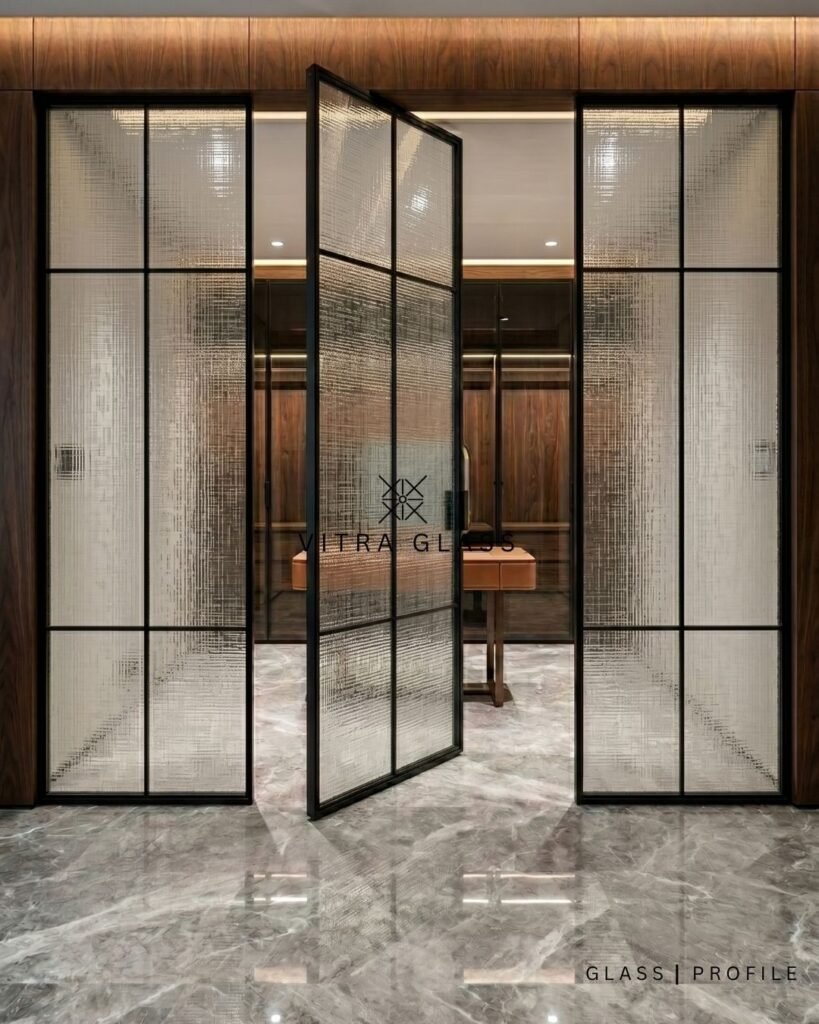
Aluminium sliding doors are the dominant choice for Indian homes in 2026 — and the reasons are practical, not just aesthetic. But the market is full of thin-profile systems that look identical to quality ones on day one and fall apart by year three.You’ve been quoted three different prices for the same balcony door. One contractor says go with uPVC. Another swears Aluminium is the only material worth considering. A third just sends a WhatsApp message with no explanation. his guide tells you what separates a ₹400/sq ft Aluminium sliding door system from a ₹900/sq ft one, which profiles hold up in coastal Maharashtra, and what questions to ask before signing any installation quote. vitraglass.in has supplied and installed Aluminium sliding door systems across the state — everything here is drawn from real projects.
Why Aluminium Dominates the Sliding Door Market in India
Strength-to-weight ratio. Aluminium is strong enough to support large glass panels — even floor-to-ceiling glass that weighs 40–60 kg per panel — without the frame deflecting or sagging over time. uPVC frames can hold smaller panels but flex visibly with heavy glass.
Corrosion resistance. Raw aluminium reacts with moisture, but anodised or powder-coated aluminium doesn’t. In coastal cities like Mumbai, Ratnagiri, or Alibag — where salt-laden air destroys steel hardware in two to three years — anodised aluminium lasts 20+ years without surface degradation.
Slim sightlines. Aluminium can be extruded into profiles as narrow as 35mm. This means the visible frame between glass panels is minimal — more glass, less metal. uPVC profiles are bulkier and block more light.
Low maintenance. Unlike timber, aluminium doesn’t warp, crack, or require repainting. Wipe it down once in a while. That’s it.
See our complete aluminium door and glass solutions at vitraglass.in for current options and project examples.
Types of Aluminium Sliding Doors — What’s Actually Available
Not all aluminium sliding doors are the same system. Here’s what the market actually offers.
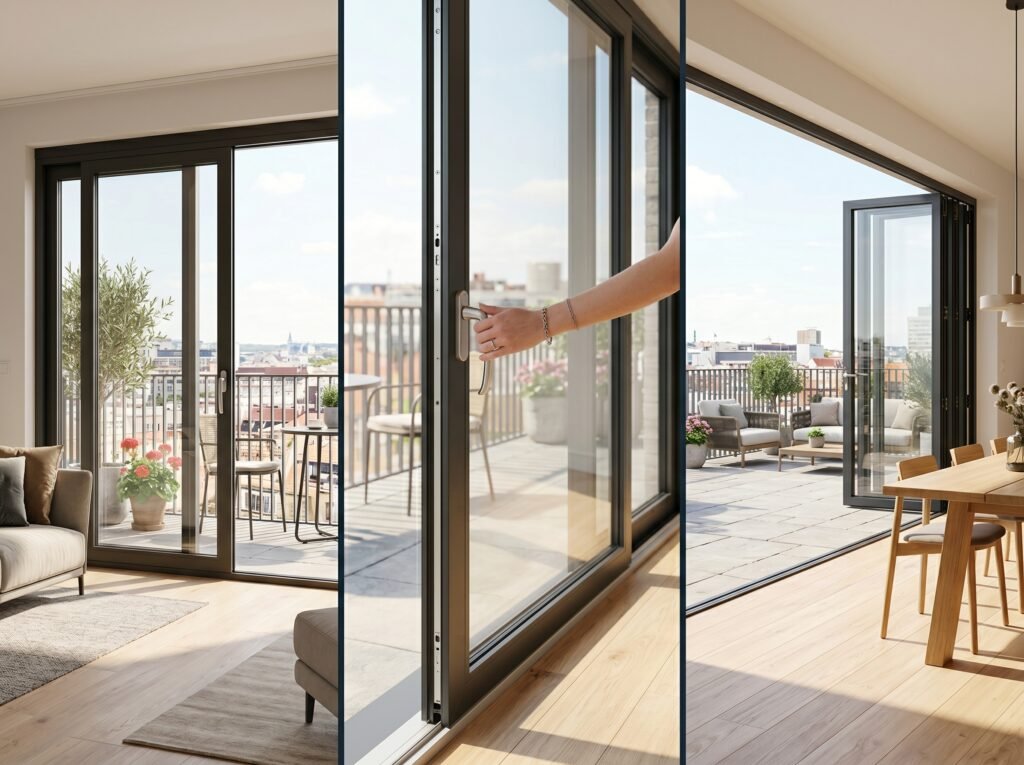
Lift and Slide Doors
The premium option. The door panel lifts slightly off its seal when you engage the handle, then glides on the track. When you close it, it drops back down onto the seal, creating an airtight compression fit.
This gives you the best thermal insulation, the best acoustic performance, and the smoothest operation of any sliding system. Large panel widths of up to 3 metres are standard with lift-and-slide.
Price premium: 40–60% above standard systems. Worth it for living room balcony doors where you want the glass to feel invisible.
Standard Sliding (Bypass) Doors
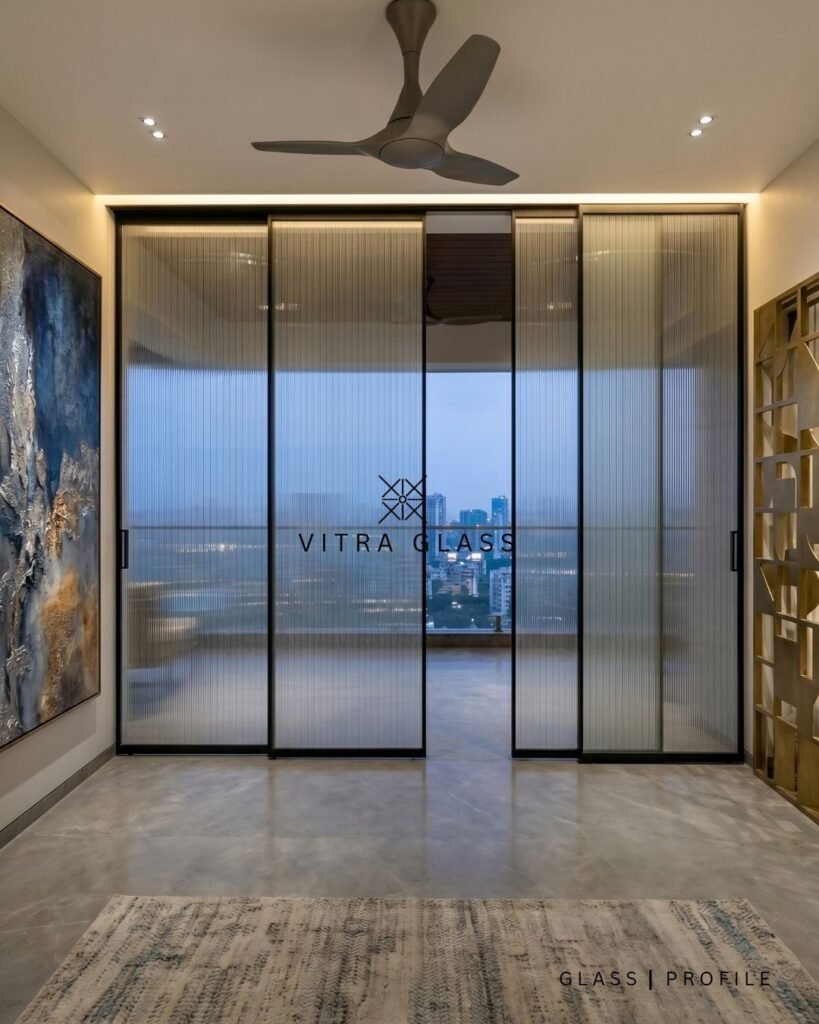
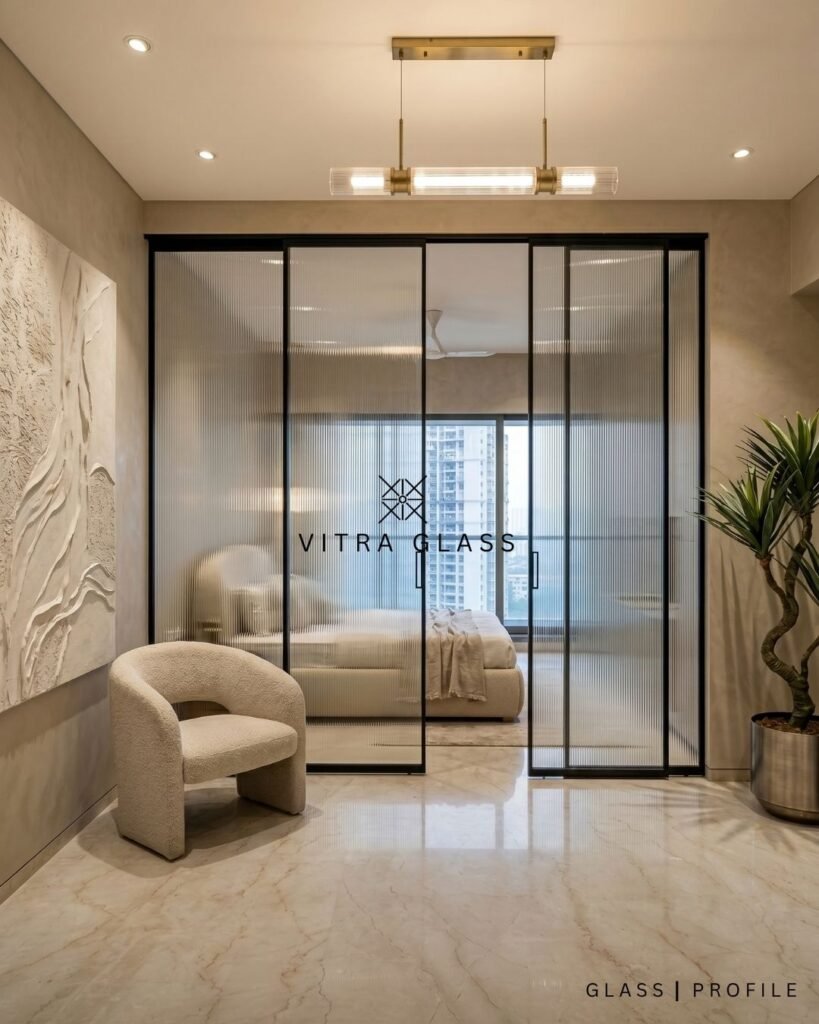
Two or more panels on parallel tracks — one slides in front of or behind the other. This is the most common system for Indian homes: balconies, bedroom terraces, service areas, and kitchen openings. Track quality is the key differentiator here. Cheap systems use thin steel runners that corrode and bind within a year. Quality systems use stainless steel or aluminium alloy runners with nylon-lined rollers — smooth for 15+ years.
Aluminium Folding Sliding Doors (Bi-Fold)
Panels that both fold and slide — typically on a top-hung track. Each panel hinges to the next, so when fully open, they stack neatly at one end of the opening. This gives you a fully open wall rather than the 50% access of a standard bypass system.
Popular for living room balconies where you want the indoor and outdoor spaces to feel like one room during good weather.
Fly Screen Integration
Most aluminium sliding door systems can be fitted with an integrated fly screen panel — a separate mesh panel that runs on the same track. The mesh slides independently of the glass panel, so you can have the door open and the screen closed.
In Maharashtra, this is near-essential for ground floor and first-floor installations where insects are a concern.
Aluminium Sliding Door Price in India (2026 — Real Numbers)
Here’s what you should actually expect to pay, broken down honestly.
| System Type | Glass Spec | Price Range (per sq ft) |
|---|---|---|
| Standard bypass — aluminium | 6mm clear glass | ₹400–₹600 |
| Standard bypass — aluminium | 8mm toughened glass | ₹600–₹850 |
| Lift and slide | 10mm double glass unit | ₹1,200–₹1,800 |
| Bi-fold aluminium | 6mm toughened glass | ₹900–₹1,300 |
| With integrated fly screen | Add-on to above | ₹150–₹250 per sq ft |
What drives prices up legitimately:
- Toughened (tempered) glass — mandatory for door panels above 1.5m height under Indian standards
- Double-glazed units (two glass layers with air gap) — for sound insulation or thermal performance
- Powder coating in custom RAL colours — add ₹80–₹120 per sq ft
- Motorised operation (remote-controlled sliding) — available for premium lift-and-slide systems
Where cheap quotes cut corners:
- Thin aluminium profiles (0.8mm wall thickness vs standard 1.4–1.6mm) — looks the same, dents easily
- Non-tempered glass in door panels (dangerous and non-compliant)
- Steel track runners instead of aluminium alloy — corrodes within 18–24 months
- No thermal break in the profile (causes condensation issues in air-conditioned rooms)
Aluminium Sliding Doors vs uPVC — Which Is Right for Your Project?
This is the most common question we get. Short answer: aluminium for larger openings and coastal locations, uPVC for smaller windows in non-coastal areas where budget is tight.
Aluminium wins when:
- The opening is wider than 5 feet or taller than 7 feet
- The location is coastal or high-humidity
- You want slim sightlines and maximum glass area
- The installation is for a main living area where aesthetics matter
uPVC works when:
- You’re glazing multiple small windows on a tight budget
- The location is inland with stable humidity
- You prefer a lower upfront cost and are fine with bulkier frames
- The panels won’t exceed 2.5 feet × 4 feet
Maintenance reality: Both require minimal maintenance when quality hardware is used. Aluminium profiles, once powder-coated or anodised, need nothing beyond occasional cleaning. uPVC profiles yellow in strong sunlight over 8–10 years — this is the long-term trade-off.
Sliding Door Channel Systems — What to Check Before Buying
The sliding door channel — the track system the door rolls on — determines how the door performs for its entire life. It’s also the part that cheap quotes shortchange most.
Top-hung vs bottom track: Top-hung systems carry the door’s weight from above. There’s a minimal bottom guide — just enough to keep the panel from swinging — but no weight-bearing channel on the floor. Smoother operation, no floor groove collecting dust and debris.
Bottom-rolling systems carry the weight on a floor channel. Cheaper, but the channel is exposed to foot traffic, cleaning water, and debris. In a busy household, bottom tracks need more frequent cleaning and the rollers wear faster.
Track material matters:
- Stainless steel: best for coastal Maharashtra — doesn’t rust
- Aluminium alloy: standard choice — good corrosion resistance, smooth operation
- Mild steel: cheapest — rusts within 2–3 years in humid conditions, avoid
Roller quality: Look for ball-bearing rollers with a stainless steel race. Plastic rollers are a red flag — they wear flat over time and start juddering when you slide the door.
Installation — What the Process Looks Like
A standard aluminium sliding door installation (single 2-panel system, 6×7 feet opening) takes approximately one full working day.
The process:
- Site measurement — the opening is measured in three places: top, middle, bottom, because openings are rarely perfectly square
- Frame fabrication — the aluminium profile is cut and welded at the corners with a 45° mitre joint for a clean look
- Glass fitting — glass panels are cut to size and fitted into the frame with EPDM rubber glazing bead (not silicone alone)
- Track installation — top track first, then bottom guide channel
- Panel hanging and adjustment — rollers are adjusted for level and smooth operation
- Sealing — perimeter silicone seal between frame and wall opening
Signs of poor installation to watch for:
- Panel that drifts open on its own (track not level)
- Visible gap between frame and wall (inadequate sealing)
- Panel that vibrates when the wind blows (glass not properly bedded in EPDM)
- Hard-to-slide operation on day one (rollers not adjusted, or track not aligned)
Why Builders & Homeowners Trust vitraglass.in for Aluminium Sliding Doors
Getting the door right the first time matters — a poorly installed sliding door is expensive to fix and disruptive to live with.
vitraglass supplies and installs complete aluminium sliding door systems with:
- Toughened glass as standard on all door panels — compliant with Indian safety standards
- 1.4mm wall thickness aluminium profiles — the professional-grade spec, not the budget-grade spec
- Anodised or powder-coated finish — your choice of colour, corrosion-resistant in coastal Maharashtra
- Stainless steel roller systems on all bottom-rolling installations
- Complete site measurement before fabrication — no gaps, no adaptation on install day
- Service across Mumbai, Pune, Thane, Nashik, Raigad, and Konkan coast
- Written quote within 24 hours — detailed, not a WhatsApp number with no breakdown
FAQs About Aluminium Sliding Doors
Q: Do aluminium sliding doors rust?
Not if they’re anodised or powder-coated correctly. Raw aluminium develops a thin oxide layer naturally — that’s actually a protective coating. But for coastal areas like Mumbai, Ratnagiri, or Alibaug, anodised aluminium (electrochemically treated) is the right spec. It lasts 20+ years in salt air without surface degradation.
Q: What glass thickness should I use for aluminium sliding doors?
6mm toughened glass is the standard for residential sliding doors up to 7 feet tall. For floor-to-ceiling panels, 8mm or 10mm is recommended for stiffness — thinner glass flexes in wind and creates an audible vibration. At vitraglass.in, we specify glass thickness based on panel dimensions, not a flat spec.
Q: Can aluminium sliding doors be made soundproof?
Not fully — but significantly better than standard single-glazed systems. A double-glazed unit (two 5mm glass layers with a 12mm air gap) in an aluminium frame reduces traffic noise by 30–35 dB. For rooms facing a busy road, this is worth the premium. Standard single-glazed aluminium sliding doors reduce noise by 20–25 dB.
Q: How do I clean and maintain aluminium sliding doors?
Clean the glass with a standard glass cleaner and the aluminium frame with a mild soap and water solution. For the track, use a dry brush to remove debris every 3–4 months. Lubricate the rollers once a year with a silicone-based spray. Avoid oil-based lubricants — they attract dust and gum up the track. That’s all the maintenance a quality system needs.
Q: What’s the difference between a sliding door and a folding sliding door?
A standard sliding door has panels that slide left or right on a track — one panel in front of another. A folding sliding (bi-fold) door has panels that both fold and slide — when fully open, they stack flat at one end, leaving the full opening clear. Bi-fold gives you a completely open wall; standard sliding gives you 50% access at most. Bi-fold costs more but transforms a living room balcony.
Q: Are aluminium sliding doors safe for children?
Yes, with the right glass spec. All door panels must use toughened (tempered) glass — this is mandatory under Indian standards for any glass panel used in doors. Toughened glass, if broken, fragments into small blunt pieces rather than dangerous shards. Vitraglass.in uses toughened glass as standard on every door panel — it’s not an optional upgrade.
The Right Sliding Door Is an Investment in the Whole Room
A quality aluminium sliding door doesn’t just separate inside from outside — it defines how the room feels. A large glass panel that slides silently, seals cleanly, and doesn’t rattle in a Pune monsoon is not a small thing.The difference between a ₹400/sq ft system and a ₹850/sq ft system isn’t visible on day one. It’s visible in year three when one door still slides smoothly and the other has a rusting track and a dragging panel.vitraglass supplies, fabricates, and installs aluminium sliding doors built to the right spec for Maharashtra’s climate — coastal or inland. Tell us your opening dimensions and we’ll give you a detailed, honest quote within 24 hours.