
Glass Door Kitchen Cabinets: Mumbai Buyer’s Guide (2026)
You picked the countertop. You picked the tiles. Then your interior designer asked, “Solid shutters or glass door kitchen cabinets?” — and you froze, because nobody actually explains what that choice costs you, in money or in maintenance.
Glass door kitchen cabinets aren’t just a look. They change how your kitchen feels — lighter, less boxy, easier to find that one spice jar without opening five shutters. But they also come with rules most carpenters won’t mention upfront: the wrong glass type chips, fogs, or turns into a fingerprint magnet within six months.
This guide covers every glass type used in Indian kitchens, what each one actually costs per shutter, how to pick based on your kitchen’s light and layout, and the maintenance nobody tells you about until it’s too late. By the end, you’ll know exactly what to tell your carpenter — and what to refuse.
What Are Glass Door Kitchen Cabinets, Really?
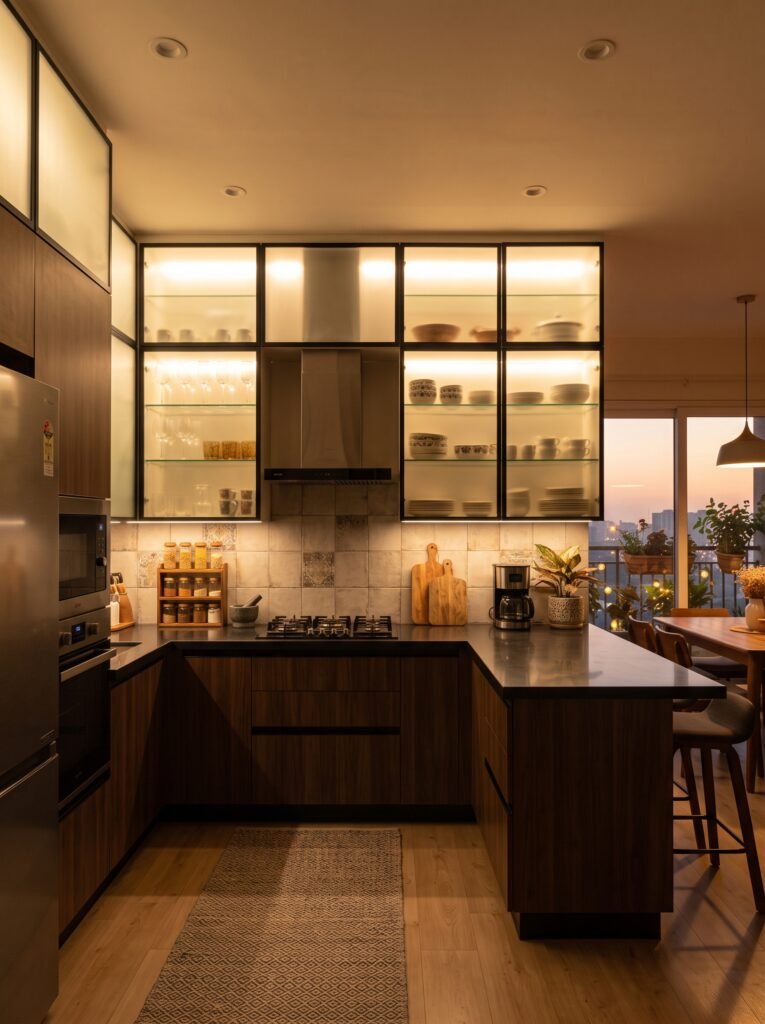
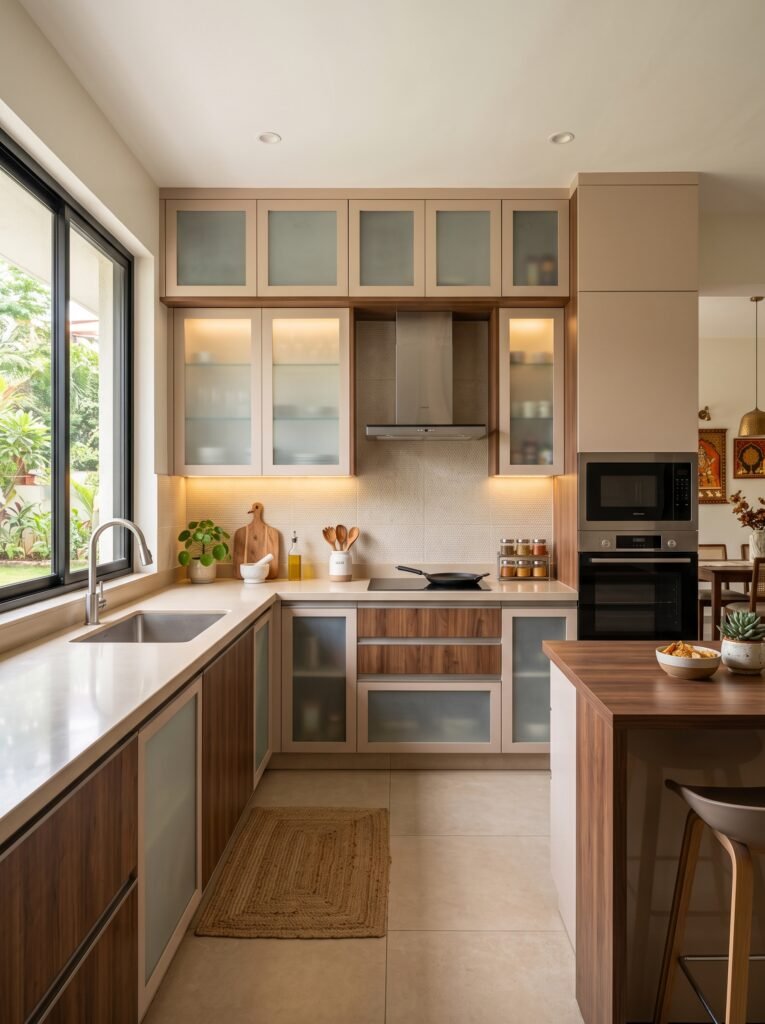
Glass door kitchen cabinets are upper (and sometimes lower) cabinet shutters where the front panel is glass instead of solid laminate or wood. The frame — usually aluminium, MDF, or wood — stays the same. Only the shutter face changes.
People choose them for one of two reasons: they want to display crockery, or they want the kitchen to feel less heavy. A small kitchen with all solid shutters can look like a wall of boxes. Swap two or three uppers to glass, and the same kitchen breathes.
The catch: glass shutters show everything behind them. Messy storage becomes visible storage. This single fact decides whether glass cabinets work for you or become a daily source of stress.
Types of Glass for Kitchen Cabinets
Not all glass is the same, and this is where most kitchen budgets go wrong — people pick the cheapest glass without knowing what they’re giving up.
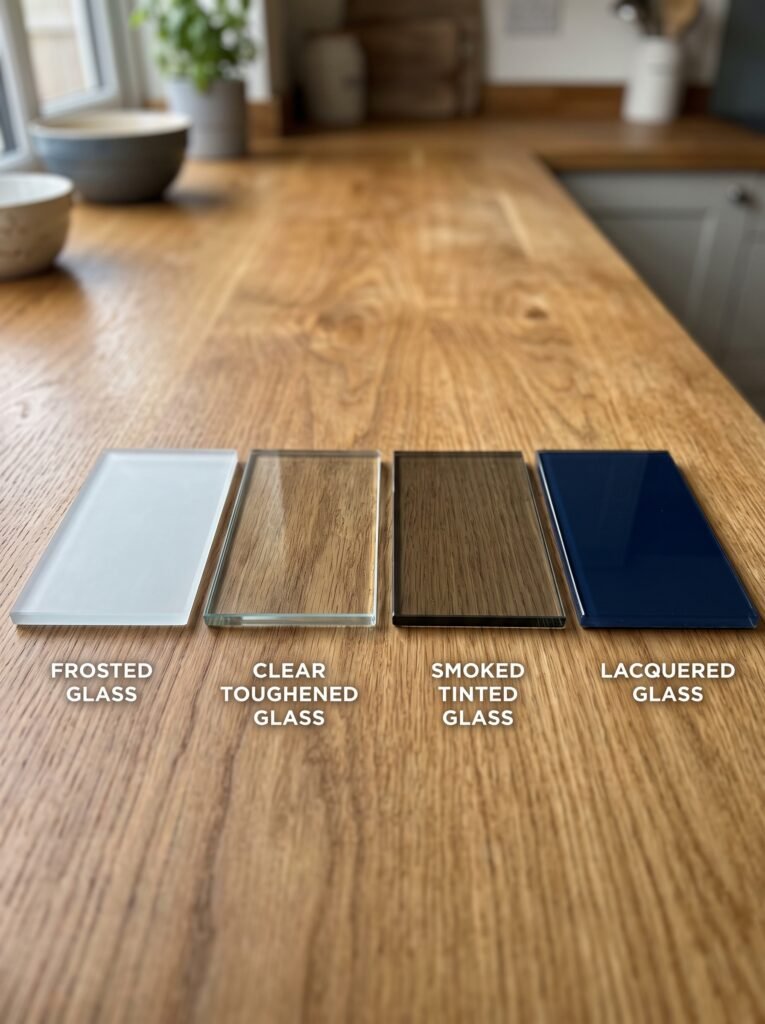
Frosted / Acid-Etched Glass
The most popular choice for Indian kitchens. It hides what’s inside while still letting light through. No visible fingerprints, no need to organise perfectly. Slightly higher cost than clear glass, but the lowest-maintenance option by far.
Clear Toughened Glass
Best if you genuinely want to display nice crockery or glassware. Looks premium in photos. In daily use, it shows every fingerprint, every speck of kitchen grease, and every messy shelf behind it. Needs cleaning almost every other day in an active Indian kitchen.
Tinted / Smoked Glass
A middle ground — grey or bronze tint that softens visibility without fully hiding it. Works well in darker, moodier kitchen palettes. Hides minor smudges better than clear glass.
Mirror or Lacquered Glass
Used more for style than storage visibility — fully opaque, reflective or solid-colour finish. Functionally behaves like a solid shutter but with a glossy, modern look.
Glass Door Kitchen Cabinets Price — What Actually Drives the Number
This is the section every carpenter conversation skips. Price isn’t one number — it’s a stack of decisions.
- Frosted toughened glass: roughly ₹150–350 per sq ft, glass only (frame and labour extra)
- Clear toughened glass: roughly ₹150–500 per sq ft
- Smoked/tinted toughened glass: roughly ₹100–750 per sq ft
- Mirror or lacquered glass: roughly ₹200–900 per sq ft
On top of glass cost, add the shutter frame (aluminium frames run ₹150–300 per running foot extra) and fitting labour, which most modular kitchen vendors bundle into a per-shutter quote rather than per sq ft.
A standard 2×2.5 ft upper shutter in frosted glass typically lands between ₹2,500 and ₹4,000 fully fitted, depending on city and vendor. Mumbai and Bengaluru quotes run on the higher end of this range; Tier 2 cities run lower.
Why two quotes for the “same” glass can differ by ₹1,000+ per shutter: toughening quality, glass thickness (4mm vs 5mm), and whether the aluminium frame is powder-coated or raw — all invisible in a sample piece but very visible after two years of daily use.
How to Choose the Right Glass for Your Kitchen
- Small kitchen, limited light → frosted or clear glass on upper cabinets only, to open up the space without losing storage discipline
- You’re not a “tidy shelf” person → frosted glass, no exceptions — clear glass will only stress you out
- South-facing or naturally bright kitchen → smoked or tinted glass, to cut glare and add depth
- You want a showcase wall for crockery → clear toughened glass, paired with interior LED strip lighting
- High footfall family kitchen → avoid clear glass entirely on lower cabinets — fingerprints at child height are a daily cleaning task
Installation — What to Check Before the Carpenter Starts
Glass shutters are fitted differently from solid ones, and a few details decide whether they last:
- Toughened, not plain glass — always. Plain glass in a kitchen cabinet is a safety risk near heat and impact; toughened glass shatters into blunt granules instead of sharp shards.
- Edge finishing matters — polished or beveled edges reduce chipping risk during years of opening and closing.
- Frame fit, not glass clips alone — glass held only by clips without a proper frame loosens faster with daily use.
- Soft-close hinges — non-negotiable for glass shutters; a hard-close hinge on glass eventually causes hairline cracks at the corners.
Installation typically adds 1–2 days to a standard modular kitchen timeline if glass shutters are ordered alongside the main cabinetry, since glass is toughened and cut to size separately from the carcass.
Maintenance — The Part Nobody Mentions
Frosted glass needs a wipe-down with a dry microfiber cloth once a week — no special cleaner required. Clear glass needs glass cleaner and a lint-free cloth every 2–3 days in an actively used kitchen, especially near the cooking zone where oil splatter settles fastest.
avoid abrasive scrubbers on tinted or lacquered glass — they dull the coating over time. And never use a kitchen cabinet glass shutter as a chopping or resting surface for hot vessels straight off the stove; even toughened glass has a thermal shock limit.
Why Vitra Glass
Vitra Glass works directly with modular kitchen vendors across Mumbai, Pune, and Bengaluru, supplying pre-toughened, edge-polished glass cut to exact shutter specifications. Every panel is BIS-compliant and quality-checked before dispatch, so vendors aren’t guessing on thickness or toughening quality — which is usually where post-installation complaints come from.
Common Mistakes to Avoid
- Choosing clear glass purely because it “looks expensive” in a showroom sample, without considering daily upkeep
- Skipping edge polishing to save a small amount — chips appear within the first year
- Mixing glass thickness across shutters in the same kitchen — looks inconsistent and complicates future replacement
- Not checking hinge type before installation — standard hinges shorten glass shutter lifespan significantly
FAQs
Q: What is the price of glass door kitchen cabinets in Mumbai?
A: Frosted toughened glass shutters typically cost ₹500–800 per shutter fully fitted in Mumbai, depending on size, thickness, and frame finish. Clear glass runs slightly lower; smoked or lacquered glass runs higher.
Q: Is glass safe for kitchen cabinets?
A: Yes, as long as it’s toughened glass — never plain glass. Toughened glass is 4–5x stronger and breaks into small, blunt pieces instead of sharp shards if it ever cracks, making it standard for Indian kitchen use.
Q: Which glass is best for kitchen cabinets — frosted or clear?
A: Frosted glass suits most Indian kitchens because it hides clutter and needs less frequent cleaning. Clear glass works only if you keep shelves consistently tidy and don’t mind cleaning every few days.
Q: How long do glass door kitchen cabinets last?
A: With toughened glass, proper edge finishing, and soft-close hinges, glass cabinet shutters typically last 12–15 years — similar to solid shutters, as long as installation quality is right.
Q: Can glass cabinet doors be installed in a rented flat?
A: Yes. Glass shutters can be fitted onto existing cabinet frames in most modular setups without structural changes, making them a common upgrade even in rented apartments.
Q: Does glass on kitchen cabinets fog up over time?
A: Frosted and acid-etched glass don’t fog with age — the frosted finish is permanent, not a coating that wears off. Clear glass can develop a light haze only if cleaned with abrasive or ammonia-heavy cleaners repeatedly.
Still deciding between frosted and clear for your kitchen? Drop your kitchen size and layout below — we’ll tell you exactly what works → [link]
Types of Glass for Kitchen Cabinets
Not all glass is the same, and this is where most kitchen budgets go wrong — people pick the cheapest glass without knowing what they’re giving up.
Frosted / Acid-Etched Glass — hides what’s inside while letting light through. No visible fingerprints. The lowest-maintenance option by far.
Clear Toughened Glass — best for displaying crockery. Looks premium in photos. Shows every fingerprint and every messy shelf behind it.
Tinted / Smoked Glass — grey or bronze tint, softens visibility without fully hiding it. Hides minor smudges better than clear glass.
Mirror or Lacquered Glass — fully opaque, reflective or solid-colour finish. Style-led choice, behaves like a solid shutter.
| Glass Type | Visibility | Maintenance | Price per sq ft |
|---|---|---|---|
| Frosted / Acid-Etched | Hidden | Low — weekly dry wipe | ₹450–650 |
| Clear Toughened | Fully visible | High — clean every 2–3 days | ₹350–500 |
| Tinted / Smoked | Partial | Medium | ₹100–650 |
| Mirror / Lacquered | Opaque | Low | ₹100–400 |