
Glass Partition for Home & Office: 6 Types, Cost & How to Choose Guide
Your architect says glass partition. Your contractor says wooden partition. The interior designer says both. And you are standing in an empty room wondering which one will still look good and which one you’ll regret by next monsoon. Glass partition is the most versatile space-divider for both Indian homes and offices — but only when the right type is matched to the right space. Get the type wrong and you get either a wall you can see everything through or a structure that vibrates every time the AC compressor kicks in.
This guide covers 6 types of glass partitions used in India, what each costs, where each type actually belongs, and the three things vitraglass.in checks before installing any partition — things most suppliers skip entirely.
What Is a Glass Partition and Where Does It Work in India?
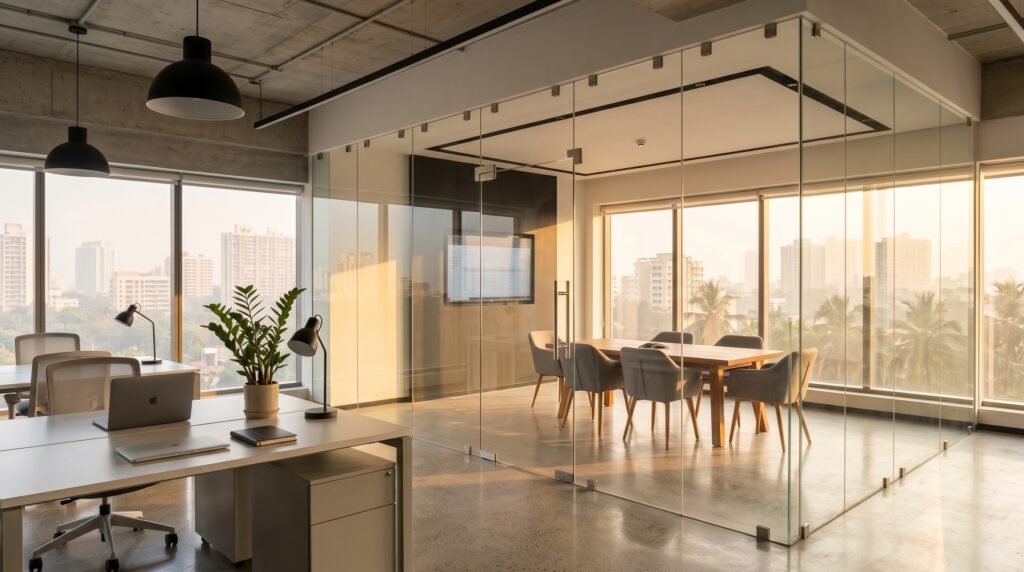
A glass partition is a non-load-bearing internal wall made of glass panels — framed, semi-framed, or frameless — used to divide spaces without blocking light or making a room feel smaller.
Unlike a masonry wall, it can be installed after construction is complete, relocated if the layout changes, and removed without major work. In cities where every square foot matters –
Glass partitions work in three broad contexts in India:
Residential: Between a living room and pooja room, between a bedroom and a study corner, as a bathroom glass partition replacing a traditional tiled half-wall, or as a balcony enclosure.
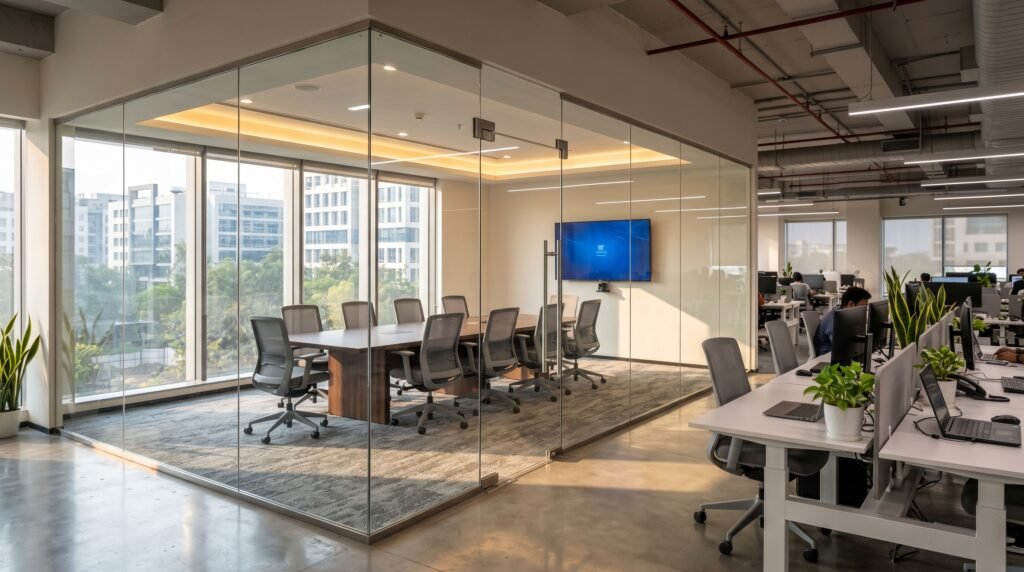
Commercial: Office floor plans, conference room dividers, reception area screens, cabin walls in coworking spaces. Glass office partitions have replaced drywall in most modern Indian commercial interiors because they maintain privacy without cutting off natural light.
Hospitality and Retail: Restaurant zone dividers, hotel lobby screens, showroom display partitions. The glass becomes part of the design, not just a functional wall.
🔗 See IS 2553 glass safety standards — bis.gov.in
6 Types of Glass Partitions Used in India
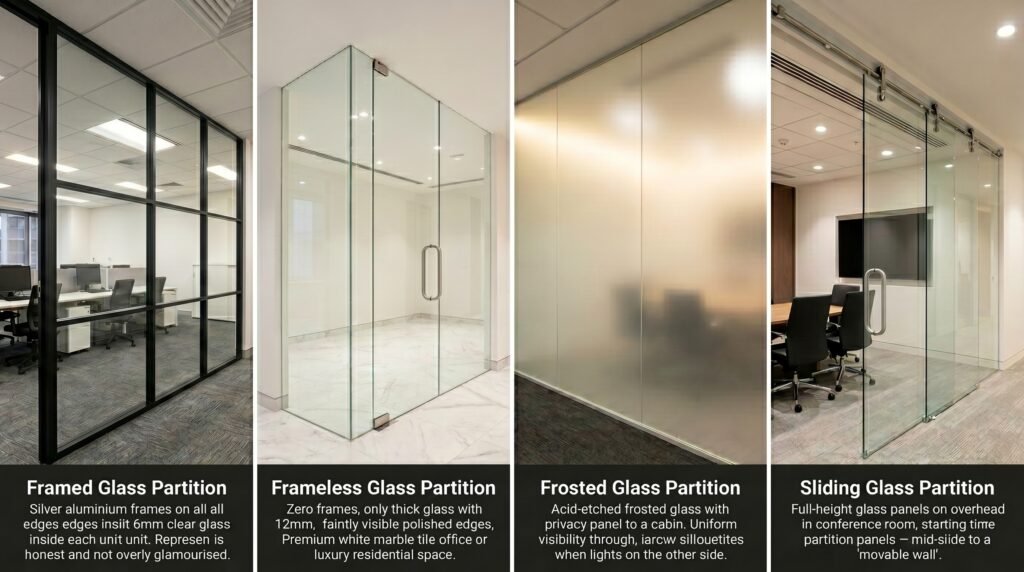
1. Framed Glass Partition
An aluminium or steel frame holds every glass panel — top, bottom, and both sides. The most common type in Indian offices built before 2020. Structurally forgiving and affordable.
Cost range: ₹350–₹600/sq ft (glass + frame + installation). Best for: Budget office fit-outs, older buildings where walls are not perfectly plumb, spaces where the partition may be relocated in 1–2 years.
The limitation: The frame visually breaks up the space. A glass partition that should make a room feel open ends up looking like a collection of small glass boxes. For homes and premium offices, this is increasingly the wrong choice.
2. Semi-Frameless Glass Partition
Wall channels at the top and floor anchor the panels. The glass panels themselves have no frame on the vertical edges between panels. The look is significantly cleaner than fully framed.
Cost range: ₹500–₹850/sq ft. Best for: Mid-tier office renovations, co-working spaces, residential study dividers. The balance point between cost and aesthetics for most Indian buyers in 2026.
3. Frameless Glass Partition
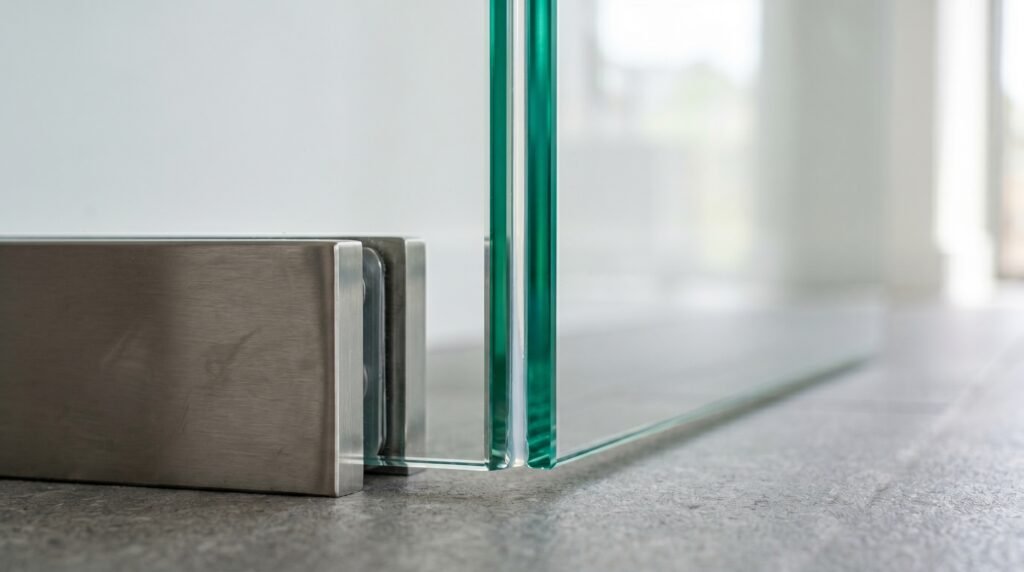
Thick tempered glass panels — 10mm or 12mm — mounted directly using wall clamps and floor channels, with no vertical frame between panels. The result is a continuous glass wall with minimal visible hardware.
Cost range: ₹800–₹1,600/sq ft depending on glass thickness and hardware finish. Best for: Premium offices, luxury homes, conference rooms, reception lobbies. The standard for high-quality commercial interiors in Mumbai and Pune.
This is the partition type that makes a space look larger than it is — because light and sightlines pass through without interruption. The cleaning effort is also the lowest — no frame channels to accumulate dust.
4. Frosted or Opaque Glass Partition
Tempered glass with a surface treatment — either acid-etched, sandblasted, or a vinyl film — that diffuses light and blocks clear visibility. Full privacy with the light-transmission benefit of glass.
Cost range: ₹500–₹1,000/sq ft depending on glass thickness and treatment type. Best for: Bathroom glass partitions, bedroom dividers, HR cabin walls in open offices, prayer rooms, any space where visual privacy is needed but light must still pass through.
Frosted glass can be combined with any frame type — framed, semi-frameless, or frameless.
5. Double-Glazed (Acoustic) Glass Partition
Two layers of glass with an air gap or acoustic interlayer between them. The result is a partition that significantly reduces noise transmission between spaces — rated to 35–45 dB reduction depending on the configuration.
Cost range: ₹1,200–₹2,200/sq ft. Best for: Conference rooms, legal offices, medical clinics, bedrooms in homes that share a wall with a noisy space. If sound control is the primary need — this is the only glass partition that actually delivers it.
A single-layer glass partition, even 12mm thick, will transmit conversation clearly. Do not expect sound privacy from a single-pane partition.
6. Sliding Glass Partition (Movable Wall)
Full-height glass panels that slide on an overhead track — individually or as a folding set. The space can be fully open or fully divided as needed, with the partition moving out of the way completely when not in use.
Cost range: ₹1,500–₹3,500/sq ft depending on panel weight and track system. Best for: Conference rooms that double as training spaces, homes where a large room needs to occasionally divide into two, hotel banquet spaces, co-working flexible zones.
The installation precision required is higher — the overhead track must be level within 1mm tolerance for smooth operation. This is not a DIY installation.
Glass Partition Price in India — What Drives the Cost in 2026
A ₹350/sq ft partition and a ₹1,600/sq ft partition are both called glass partitions. Here is the breakdown.
- Glass thickness: 6mm glass in a framed partition costs ₹80–₹120/sq ft for the glass alone. 10mm tempered glass costs ₹160–₹240/sq ft. 12mm costs ₹220–₹320/sq ft. Thickness determines how the partition flexes, seals, and behaves if ever impacted.
- Frame material and grade: Standard aluminium sections cost ₹180–₹280 per running metre. Powder-coated or anodised aluminium costs 30–40% more but resists corrosion in coastal cities like Mumbai. Stainless steel 304 sections are the premium choice — they last without fading or pitting.
- Glass type: Clear tempered is the base. Frosted, tinted, or patterned glass adds ₹80–₹200/sq ft over clear. Double-glazed units are bespoke — price on measurement.
- Hardware finish: Standard chrome clamps and handles show fingerprints and watermarks constantly. Brushed stainless or matte black finishes cost 20–35% more but look better longer — especially in office settings where the partition is touched hundreds of times a day.
- Installation complexity: A straight run of framed partition on level floors installs in 4–6 hours. A frameless partition with precise wall drilling, level-set panels, and silicone sealing takes 8–12 hours. Budget ₹50–₹120/sq ft for installation labour depending on type.
A price range summary for 2026:
| Type | All-in cost per sq ft |
|---|---|
| Framed glass partition | ₹350–₹600 |
| Semi-frameless | ₹500–₹850 |
| Frameless | ₹800–₹1,600 |
| Frosted glass partition | ₹500–₹1,000 |
| Acoustic double-glazed | ₹1,200–₹2,200 |
| Sliding movable partition | ₹1,500–₹3,500 |
How to Choose the Right Glass Partition for Your Space
These five questions narrow the decision in under two minutes.
Do you need privacy or just separation? If you need to divide a space but both sides should feel connected — frameless clear glass. If you need visual privacy — frosted. If you need acoustic privacy — double-glazed. Is the partition permanent or temporary? Permanent, high-use partition in a premium space → frameless, 10–12mm glass. Temporary or budget-first → framed, 6–8mm.
What is the room’s natural light situation? A dark interior should never use an opaque partition. If the only window is on one side of the proposed partition, clear or lightly frosted glass is the only choice that won’t turn half the room into a dim box. Is this a wet area? Bathroom glass partition and shower glass partition installations need tempered glass certified to BIS IS 2553, waterproof silicone sealing at all edges, and hardware that is explicitly rated for humid environments. Not all office partition systems are appropriate for wet areas.
What does the wall condition look like? Frameless partitions need walls within 3mm of perfectly plumb. Older buildings often don’t meet that. A semi-frameless or framed system handles the variation better.
Why Architects and Homeowners Choose vitraglass for Glass Partitions
vitraglass.in fabricates and installs glass partitions from verified BIS-certified glass. Every project starts with a site measurement visit — not a catalogue quote.
- Tempered glass in 6mm, 8mm, 10mm, and 12mm — fully BIS IS 2553 certified
- Framed, semi-frameless, frameless, frosted, and acoustic partition systems all available
- Aluminium, powder-coated, and 304 stainless steel frame options to match project specs
- 600+ projects completed across residential, commercial, and hospitality sectors in Maharashtra Site measurement, fabrication, installation, and silicone sealing — all in one scope
- Free estimate provided within 24 hours of enquiry — no measurement charge
Frequently Asked Questions About Glass Partitions
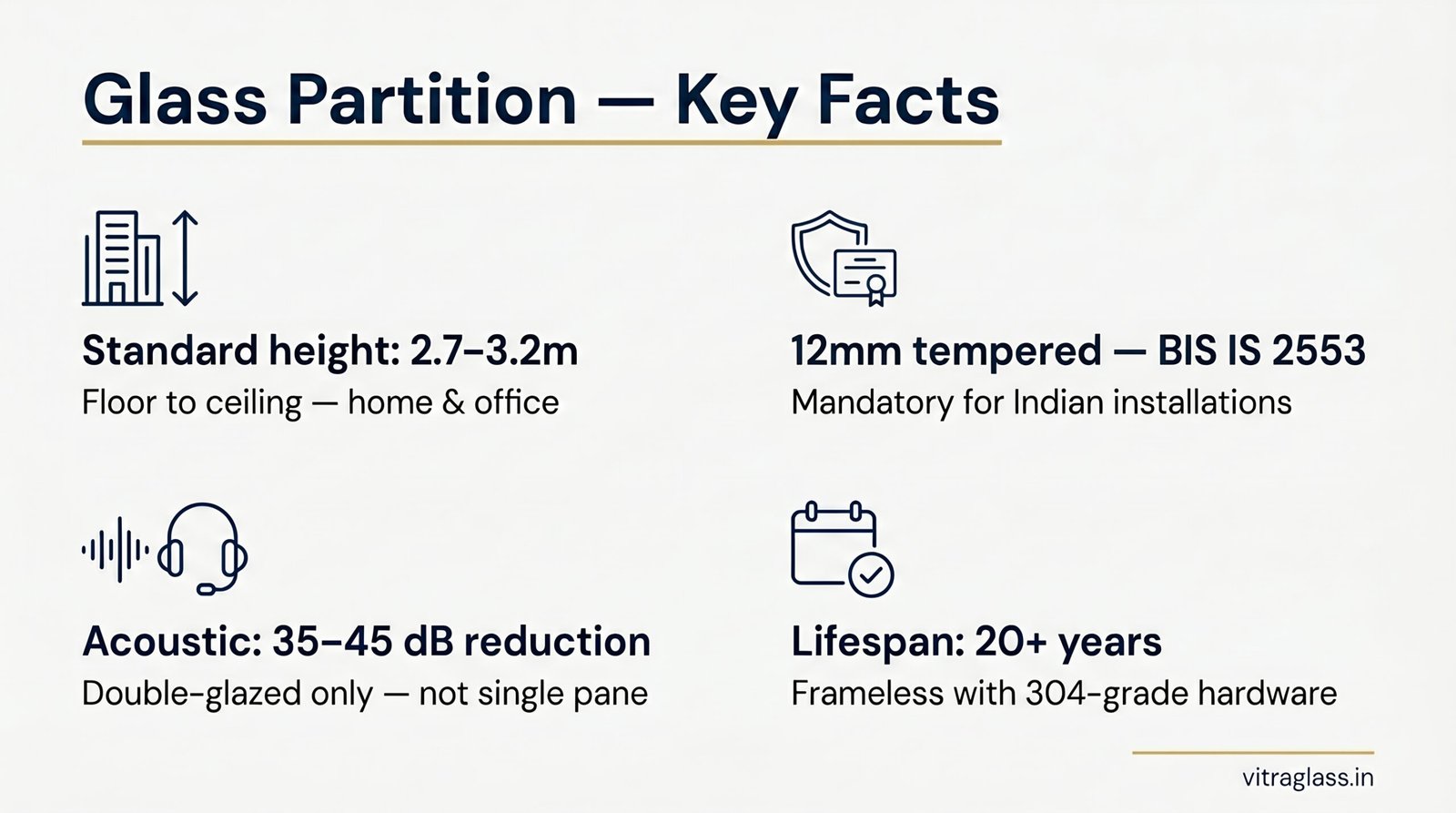
Q: What is the standard height for a glass partition in India? Full-height glass partitions in Indian offices run floor to ceiling — typically 2.7m to 3.2m depending on the building’s slab height. Residential partitions are often partial-height — 1.2m to 1.8m — for a visual divide without fully closing off the space. The ceiling track or wall clamp type changes based on whether the partition goes to the ceiling or stops short.
Q: Is a glass partition safe in a home with children? Yes, when specified correctly. Tempered glass meeting BIS IS 2553 is 4–5x stronger than regular glass and breaks into small, blunt fragments rather than sharp shards if ever impacted. For homes with young children, 10mm tempered glass with rounded edges and no sharp hardware points is the standard specification vitraglass.in uses.
Q: Can a glass partition block noise? A standard single-pane glass partition — even 12mm thick — does not block conversation. Sound travels through glass efficiently. If noise reduction is the requirement, specify an acoustic double-glazed partition with a minimum 35 dB rating. This is the only glass partition configuration that provides genuine acoustic separation.
Q: What is the difference between a glass partition and a glass wall? A glass partition is a non-structural internal divider — it supports only its own weight and carries no structural load from the building. A glass wall (curtain wall or structural glazing) is part of the building envelope and requires engineering sign-off. Internally, the terms are often used interchangeably, but the correct term for office and home dividers is partition.
Q: How long does a glass partition last? A frameless tempered glass partition with 304-grade hardware lasts 20+ years with standard maintenance. The glass itself is indefinitely durable — it does not warp, rot, or discolour. The hardware (clamps, hinges, handles) and silicone seals are the maintenance items, typically needing attention at 8–12 years depending on usage and environment.
Q: Can vitraglass.in install glass partitions in an existing office without major disruption? Yes. Glass partition installation does not require demolition or wet work. A typical 10m run of frameless partition installs in one working day. vitraglass.in schedules installations to minimise operational disruption — early morning or weekend slots are available for commercial projects.
Glass Partition Safety Standards You Should Know
Before choosing a glass partition for your home or office, it is important to check whether the glass meets recognised safety standards. In India, tempered safety glass should follow BIS guidelines, especially when used in bathrooms, office cabins, balcony enclosures, shower partitions, and high-use interior spaces.
A good-quality glass partition should not only look clean and modern but also be strong enough for daily use. Proper glass thickness, polished edges, certified tempered glass, corrosion-resistant hardware, and professional installation all play a role in long-term safety.
For more information, you can refer to the official Bureau of Indian Standards website for Indian safety standards: https://www.bis.gov.in/
Choosing BIS-certified glass helps ensure that your partition is safer, more durable, and suitable for Indian residential and commercial interiors.
The Right Glass Partition Is a 20-Year Decision
A glass partition is not a piece of furniture you replace when it wears out. Done right, it is a structural feature of the space that shapes how the room works every day.
The cost difference between a cheap framed system and a proper frameless installation is ₹300–₹400/sq ft. Spread over 20 years, that is less than the cost of repainting a wall once. The difference in what you live and work with every day is not comparable. vitraglass will measure the space, recommend the right type for the specific use, and install it without shortcuts.
Ready to see what the right glass partition looks like in your space?
Also read: 5 Types of Shower Cubicles in India — Glass, Price & What Lasts (2026 Guide)