
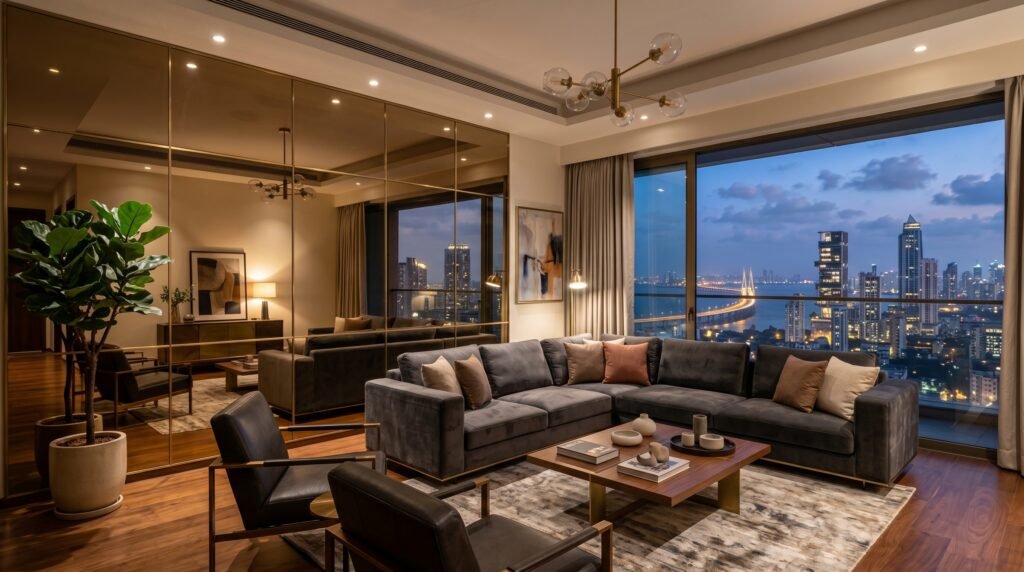
Mirror Wall for Living Room – Best Guide 2026
You’ve been in your living room, looked at that blank wall, and thought: “A mirror here would open this place up.” You’re not wrong. But then you opened Instagram, saw 40 different mirror wall designs, got a quote from one contractor, and suddenly had more questions than answers.A mirror wall for living room spaces in Mumbai is one of the most common upgrades we help homeowners with at vitraglass.in — and one of the most misunderstood. The wrong mirror type in the wrong space can look cheap in six months. The right one can make a 500 sq ft flat feel like double the size.
This guide breaks down everything Mumbai buyers need to know — types, prices, what to watch out for, and how to choose without regret.
What Is a Mirror Wall — and Why It Works So Well in Mumbai Homes
A mirror wall is exactly what it sounds like: a wall, or a large portion of one, covered with mirror glass. But that’s where the simple explanation ends.
In Mumbai specifically, where flats are compact, natural light is often compromised by surrounding buildings, and living rooms double as guest areas, a well-placed mirror wall does three things at once: it makes the room look wider, bounces available light deeper into the space, and creates a visual focal point that makes even a basic sofa set look intentional.
The key word there is “well-placed.” A mirror wall facing a cluttered corner or a window with a bad view outside doubles everything you don’t want to see.
Here’s what most people don’t realise: the glass you choose matters as much as where you put it.
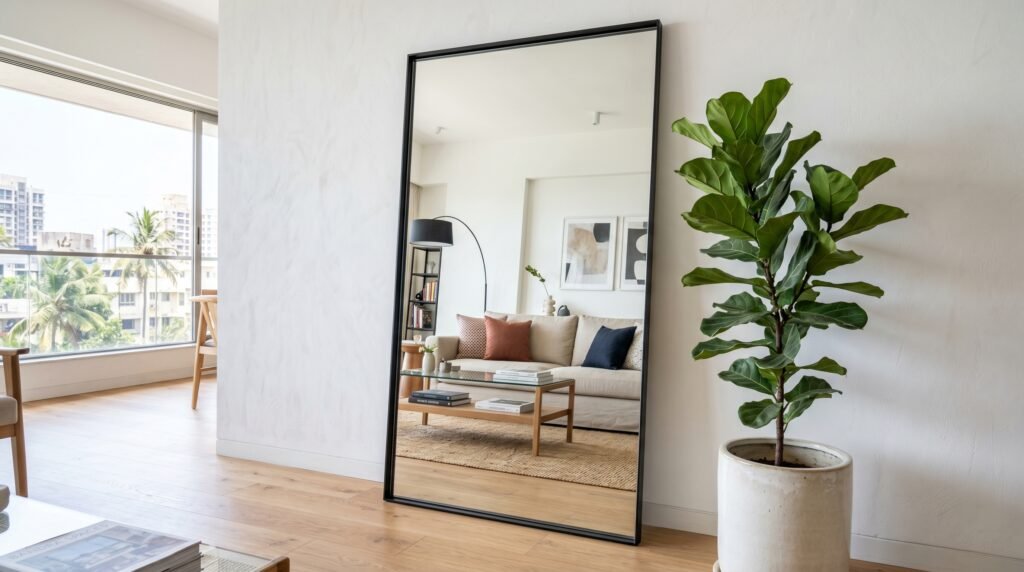
Types of Mirror Wall Designs for Living Rooms
Not all mirror walls are the same — and the design you choose determines both your final cost and how long it holds up in Mumbai’s humidity.
1. Full-Panel Mirror Wall
One large mirror sheet covering the entire wall, seamless or with minimal joins. Creates the most dramatic “room doubling” effect. Works best in 3BHK and above living rooms where the wall is at least 8–10 feet wide.
Best for: Sea-facing or corner flats where you want to maximise light. Not ideal for walls with uneven plaster — every bump reads in the reflection.
2. Tiled Mirror Wall (Grid Pattern)
Multiple smaller mirror panels arranged in a grid or staggered pattern, with thin gaps or metal trim between them. More forgiving on walls that aren’t perfectly flat. Popular in Mumbai apartments for exactly this reason.
Best for: Compact living rooms in 1BHK and 2BHK flats. The segmented look is also more modern and less “salon-like.”
3. Antique Mirror Wall
Glass with a deliberately aged, distressed backing — creates a warm, textured reflection instead of a sharp clear one. Reflects light softly rather than directly. Far more forgiving of imperfections in the room.
Best for: Living rooms with traditional or transitional interiors. Works beautifully in Bandra, Chembur, and South Mumbai homes where the architecture already has character.
4. Tinted Mirror Wall
Mirror with a slight bronze, grey, or gold tint. Adds a rich tone to the reflections and looks exceptional in evening lighting. Slightly less reflective than clear mirror, which some homeowners actually prefer — the reflection is flattering without being stark.
Best for: Formal living rooms and drawing areas where you want elegance, not raw brightness.
5. Backlit Mirror Wall
Mirror panels with LED lighting recessed behind them or along their edges. Creates a floating, glowing effect in the evenings. Requires electrical planning in advance.
Best for: Accent walls in premium living rooms and home offices that double as client meeting spaces.
Mirror Wall Price in Mumbai — What to Actually Expect
This is the question everyone has, and the answer most contractors avoid giving clearly.
Here’s a realistic breakdown for mirror wall for living room in Mumbai in 2026:
| Mirror Type | Material Cost (per sq ft) | With Installation |
|---|---|---|
| Clear tiled mirror (basic) | ₹180 – ₹250 | ₹280 – ₹380 |
| Full-panel clear mirror | ₹220 – ₹300 | ₹350 – ₹480 |
| Antique mirror | ₹320 – ₹420 | ₹450 – ₹580 |
| Bronze/grey tinted mirror | ₹350 – ₹480 | ₹500 – ₹650 |
| Backlit mirror wall | ₹600 – ₹900+ | ₹850 – ₹1,200+ |
A standard 8×8 ft mirror wall in a Mumbai living room (64 sq ft) will typically cost ₹18,000 – ₹35,000 for clear or antique options, inclusive of material and installation. Backlit or frameless full-panel designs with premium glass can go to ₹60,000–₹80,000 for the same area.What drives the price up? The quality of the mirror backing (silver vs. aluminium backing ages very differently in humid climates), the thickness of the glass (5mm vs. 6mm), the installation method (adhesive vs. clips vs. channel framing), and who’s doing it.
What drives the price down in ways you’ll regret? Thin 4mm glass that flexes and distorts. Aluminium-backed mirror that starts showing black edge spots in 18–24 months in a Mumbai kitchen-facing wall. And contractors who skip the silicone seal behind the panel, which is what causes mirror glass to pop off the wall in the monsoon season.
How to Choose the Right Mirror Wall for Your Living Room
You don’t need a designer’s eye to make this decision. You need to answer four questions honestly.
1. Which wall are you mirroring? Avoid walls that face directly into another room’s clutter, the kitchen, or a window that shows the building compound. The best mirror wall placement in a Mumbai flat is usually the wall opposite the main window — it catches natural light and bounces it back into the room.
2. How humid is your space? Flats in Lower Parel, Worli, Dadar (sea-adjacent), or older buildings with ventilation issues need silver-backed mirror glass with sealed edges — not the cheaper aluminium-backed variety. The black edge spots you’ve probably seen in older gym mirrors? That’s aluminium backing oxidising. It won’t fix itself.
3. What’s the existing décor doing? If your living room has warm tones — wooden flooring, beige walls, earthy furniture — a clear mirror can look cold and clinical. An antique or bronze-tinted mirror would sit far more naturally. If your living room is already modern and minimal, clear or grey-tinted mirrors work well.
4. Is this a rental or a permanent home? If you’re renting, go with clip-mounted or channel-framed tiled mirror panels — they can be removed without damaging the wall. If you own the flat, full-panel adhesive-bonded mirrors give the cleanest look and hold better long-term.
Why Homeowners in Mumbai Trust vitraglass.in for Mirror Wall Projects
Most mirror wall jobs go wrong not because of the design choice — but because of the execution. Poorly bonded panels. Wrong glass thickness. No edge polishing. Mirror installed without checking the wall’s moisture level first.
At vitraglass.in, we handle mirror walls the way Mumbai’s humidity demands — not the way catalogue photos make them look easy.
- 5mm and 6mm silver-backed mirror glass, sealed edges on all panels
- 100+ residential projects completed across Mumbai, Thane, and Navi Mumbai
- In-house installation team — not outsourced labour
- Site visit before quoting — we check wall condition, moisture, and sunlight angle
- Dispatch and installation within 7–10 working days of order confirmation
A client in Andheri West came to us after a contractor had installed tiled mirrors in her living room — beautiful on day one, black-edged in 18 months because the building compound-facing wall had slow moisture ingress. We replaced the panels with proper moisture-resistant sealed mirror and added silicone expansion joints behind each tile. Two years later, not one spot.That’s the kind of job you want done once.
Maintenance Tips for a Mirror Wall in Mumbai
Install it right and it’s near-zero maintenance. Install it wrong and you’ll be cleaning water stains and black spots every monsoon.
Day-to-day cleaning: Use a microfibre cloth with diluted glass cleaner. Avoid circular scrubbing — wipe in one direction to prevent micro-scratches over time. Don’t use ammonia-based cleaners on tinted or antique mirror — it strips the backing finish.
Monsoon care: Check the edges of your mirror wall once before the monsoon season (around May-June in Mumbai). If you see any gap between the edge and the wall, a thin line of transparent silicone sealant re-applied is all it takes. Takes 10 minutes and saves you a full replacement.
Long-term: Quality mirror glass in a properly installed, sealed mirror wall will last 10–15 years without edge deterioration. Budget mirror with aluminium backing in a humid space may start showing spots in as little as 18 months.
FAQs — Mirror Wall for Living Room Mumbai
Q: What is the typical cost of a mirror wall in a Mumbai living room?
For a standard 8×8 ft clear or antique tiled mirror wall in Mumbai, expect ₹18,000–₹35,000 inclusive of material and installation. Backlit or full-panel frameless designs for the same area run ₹55,000–₹80,000. The range is wide because glass thickness, backing quality, and installation method all change the number significantly.
Q: Can a mirror wall be installed in a rented Mumbai flat?
Yes. Choose clip-mounted or channel-framed tiled mirror panels — they mount with minimal wall damage and can be removed cleanly when you move. Avoid adhesive full-panel mirror in rentals; the bonding is strong and wall damage during removal is likely.
Q: Which direction should a living room mirror wall face in a Mumbai flat?
The wall opposite your main window is typically ideal — it reflects natural light back into the room and amplifies daylight. Avoid placing a mirror wall where it directly reflects a cluttered area, the kitchen, or an unattractive outdoor view, as the reflection doubles what’s already there.
Q: Is mirror glass safe for living rooms with children?
Yes, when the right glass is used. Mirror glass installed for living room walls should be a minimum of 5mm thickness. For homes with young children or high-traffic spaces, ask for toughened (tempered) mirror glass — it meets IS 2553 safety standards and, if broken, fractures into small blunt pieces rather than sharp shards.
Q: How long does a mirror wall last in Mumbai’s climate?
A properly installed mirror wall with silver-backed glass and sealed edges will last 10–15 years without deterioration, even in Mumbai’s humidity. The common cause of early failure — black edge spots and separation — is almost always aluminium-backed mirror or unsealed edges, not the glass itself.
Q: Does vitraglass.in do mirror wall installation outside Mumbai?
Yes. vitraglass.in serves Mumbai, Thane, Navi Mumbai, and Pune for residential and commercial projects. For locations further afield, material supply with detailed installation guidance is available.
The Bottom Line
A mirror wall for your living room is one of the highest-impact, lowest-footprint upgrades you can make in a Mumbai flat — if the glass and installation are done right. Get the glass thickness, backing quality, and placement right, and it works for you every single day.
Get a free estimate for your living room from vitraglass.in in 24 hours → vitraglass.in/contact
Still unsure which mirror type suits your space? Drop your room dimensions and wall description in the comments — we answer every one.