
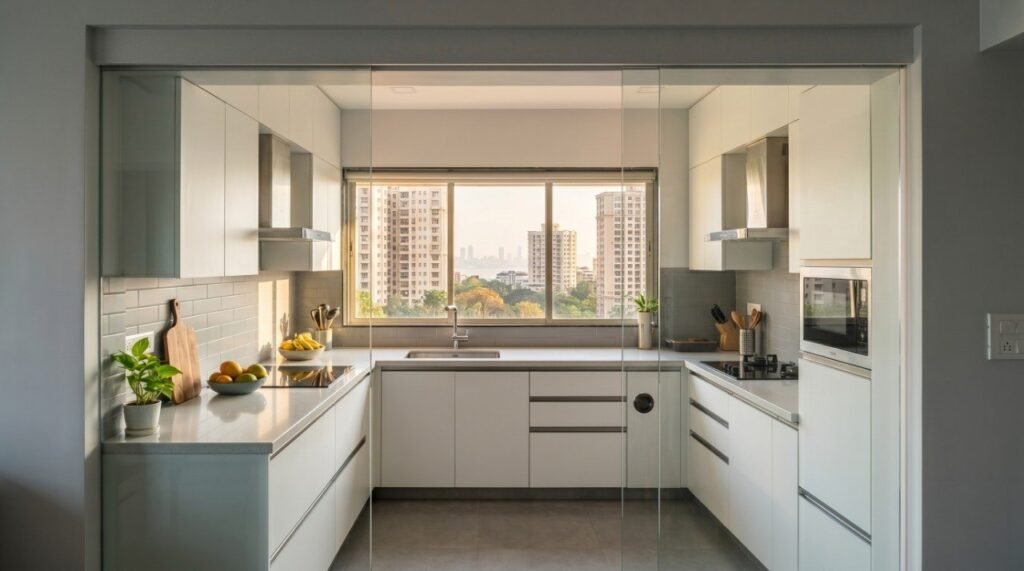
Kitchen glass sliding doors have become one of the most practical upgrades in Mumbai flats right now. Tight spaces, open layouts, and the need to block cooking smells — all three problems, one solution. Whether you’re in a 2BHK in Andheri or a duplex in Powai, a glass sliding door changes how your kitchen feels and functions.
Kitchen Glass Sliding Door Ideas for Mumbai Homes (2025 Guide)
Kitchen glass sliding doors have become one of the most practical upgrades in Mumbai flats right now. Tight spaces, open layouts, and the need to block cooking smells — all three problems, one solution. Whether you’re in a 2BHK in Andheri or a duplex in Powai, a glass sliding door changes how your kitchen feels and functions.
We’ve installed these across 500+ projects in Mumbai, Pune, and Hyderabad. So in this guide, we’re sharing 5 real ideas that actually work — with honest pros, cons, and rough price ranges.
1. Frameless Glass Sliding Door — The Clean Look Everyone Wants
No frame. No visible hardware on the sides. Just a clean sheet of glass that slides on a top-mounted track.
This works beautifully in modern Mumbai kitchens — especially open-plan layouts in Bandra or Juhu apartments where the kitchen connects to the living area. The glass doesn’t break the visual flow of the room.
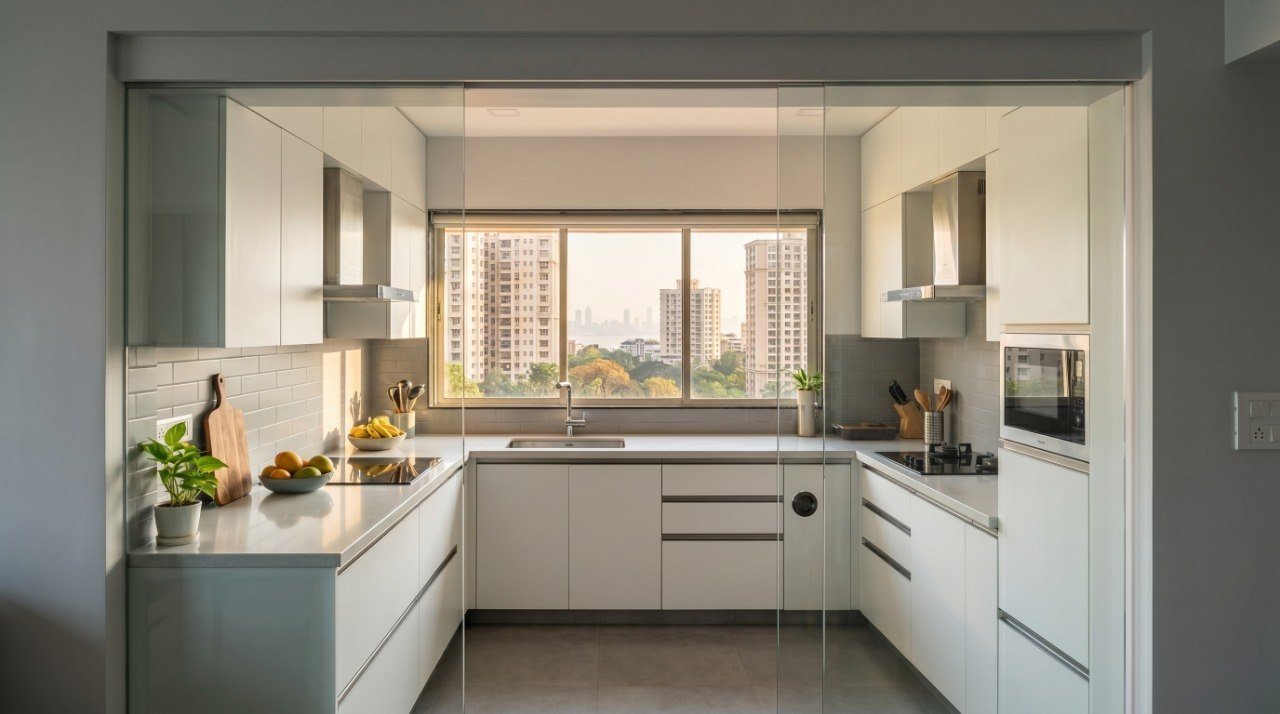
We use IS 2553 Part 1 certified toughened glass (check BIS standards here) — 10mm or 12mm thick. It’s strong enough to handle daily use without bowing or cracking.
Rough price range: ₹850–₹1,200 per sq ft installed.
Honest drawback: Frameless doors need precise installation. If the wall or floor isn’t level (common in older Mumbai buildings), the door can wobble or not slide smoothly. Always get a site measurement done first.
2. Frosted Glass Sliding Door — Privacy Without Losing Light
Full transparency isn’t always what you want. If your kitchen faces the main hall or dining area, frosted glass gives you privacy while still letting light pass through.
This is very popular in Mumbai homes where the kitchen helper is working and guests are sitting in the living room. You don’t want full visibility, but you also don’t want a solid wall blocking light.
Frosted glass is available in different opacity levels — full frost, partial frost (bottom half only), or a gradient pattern. The partial frost option looks especially good in Powai and Thane high-rises.
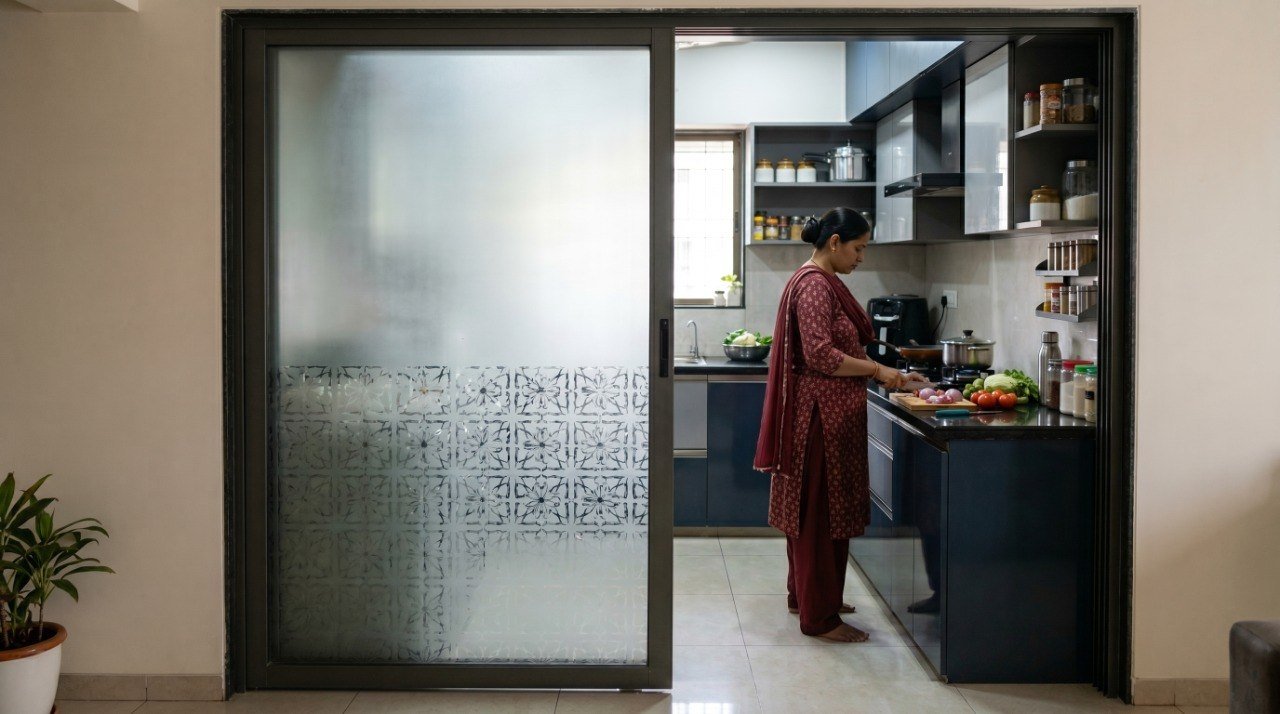
Honest drawback: Frosted glass shows fingerprints and oil smudges more than clear glass. In a kitchen environment, you’ll need to wipe it down more regularly.
Rough price range: ₹750–₹1,050 per sq ft installed.
If you’re also thinking about bathroom applications, check out our bathroom glass partition options — similar concept, different use.
3. Aluminium-Framed Glass Sliding Door — Practical, Budget-Friendly
Not everyone needs frameless. Sometimes you just want something that works, lasts long, and doesn’t cost a fortune.
Aluminium-framed sliding doors use a slim profile frame — we offer 16x45mm (standard) and 16x35mm (ultra slim) options. The ultra slim profile gives you a cleaner look without the full frameless price tag.
This is probably our most-installed option in Mumbai kitchens. It’s practical for older buildings in Andheri West or Chembur where walls aren’t perfectly square, because the frame hides the gaps and adjusts better.
Honest drawback: The frame is visible, so it doesn’t give you that completely open, premium look. But honestly, for most kitchens — it doesn’t matter.
Rough price range: ₹550–₹800 per sq ft installed.
💬 Want to know which option fits your kitchen? WhatsApp us your kitchen dimensions and we’ll give you a straight answer — no sales pitch.
4. Tinted Glass Sliding Door — For Kitchens That Face Direct Sunlight
Mumbai sun is no joke. If your kitchen faces west or south, clear glass will let in heat and glare throughout the afternoon.
Tinted glass — bronze, grey, or green tint — reduces solar heat gain and cuts down on glare. It still looks good, lets in diffused light, and doesn’t make the kitchen feel dark.
We’ve installed bronze-tinted sliding doors in several Juhu and Versova apartments where the kitchen gets direct western sun. The difference in afternoon temperature is noticeable.
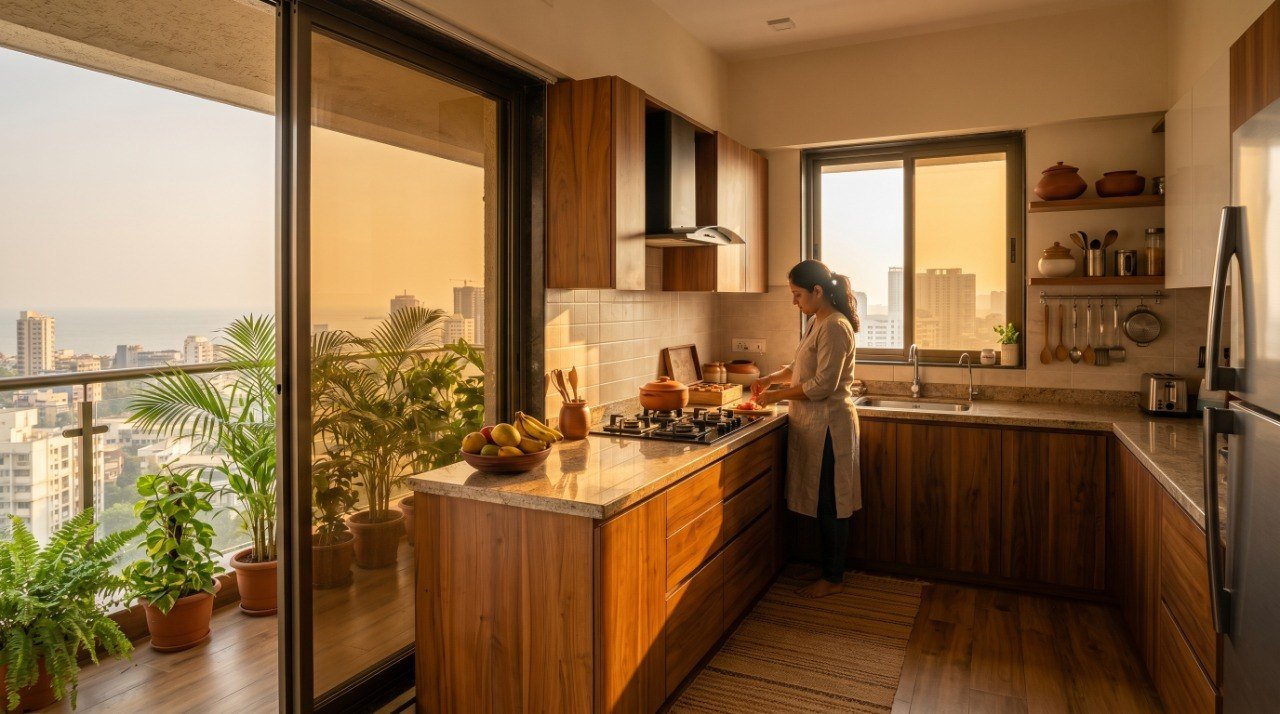
Honest drawback: Tinted glass slightly alters the colour of the space. If you have a white kitchen interior, a dark tint can make it feel smaller or gloomier in the evenings when natural light is gone.
Rough price range: ₹700–₹1,000 per sq ft installed.
5. Dual-Panel Bypass Sliding Door — Best for Wide Kitchen Openings
Some Mumbai kitchens — especially in older bungalows or new large-format apartments in Hyderabad and Pune — have wide openings, 6 to 8 feet or more. A single sliding panel won’t cover that.
A dual-panel bypass system uses two panels that slide past each other on separate tracks. When open, both panels stack on one side. When closed, they cover the full width.
This works well for open-plan kitchens in new developments across Bandra Kurla Complex or Wakad, Pune, where builders leave large pass-through openings between kitchen and dining.
Honest drawback: Dual-panel systems need more wall space on one side for the panels to stack. If your kitchen wall space is tight, this might not work — or may need a custom layout.
Rough price range: ₹900–₹1,400 per sq ft installed (both panels combined).
Also read: our complete guide to glass sliding doors in Mumbai — covers track systems, hardware, and maintenance in detail.
How to Choose the Right Kitchen Sliding Door for Your Mumbai Flat
There’s no single “best” option. It depends on three things: your budget, your kitchen layout, and how you actually use the space.
| Door Type | Best For | Price Range (per sq ft) |
|---|---|---|
| Frameless Clear Glass | Modern, open-plan kitchens | ₹850–₹1,200 |
| Frosted Glass | Privacy-first, light-friendly | ₹750–₹1,050 |
| Aluminium-Framed | Budget-conscious, older buildings | ₹550–₹800 |
| Tinted Glass | Sun-facing kitchens | ₹700–₹1,000 |
| Dual-Panel Bypass | Wide openings, large kitchens | ₹900–₹1,400 |
One practical tip: don’t finalise anything without a site measurement. What looks good on a screen may not work in your actual kitchen once you account for ceiling height, slab thickness, and door swing clearance.
We offer free site measurement across Mumbai, Pune, and Hyderabad. Fabrication takes 7–10 working days after confirmation.
What Hardware and Track System Should You Use?
The door is only as good as the hardware holding it.
For most kitchen sliding doors, we recommend a top-hung system — the track is mounted on the ceiling or a header beam, and the door hangs from it. Floor guide only at the bottom. This keeps the floor clean and easier to mop — important in Mumbai kitchens where spills happen.
For heavier frameless glass panels (10mm–12mm), use stainless steel rollers rated for the panel weight. Cheap zinc rollers squeak and wear out in 2–3 years. It’s worth paying a little more for quality hardware upfront.
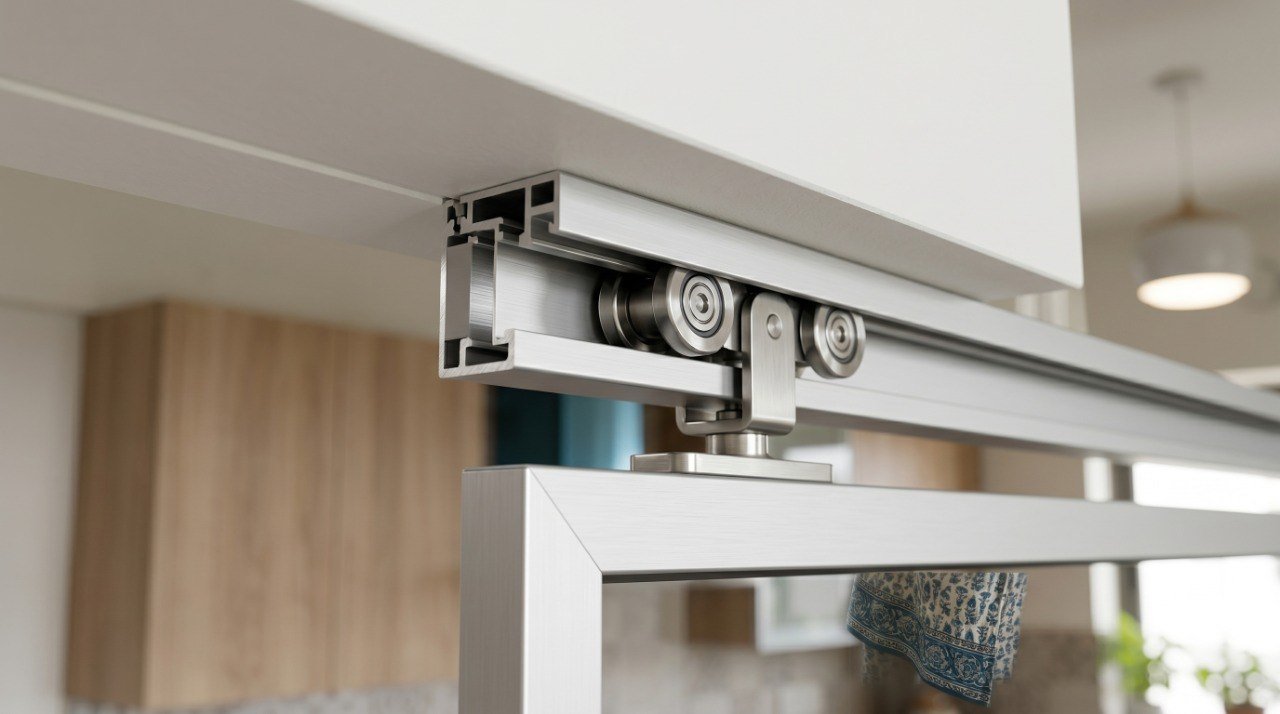
Track profiles we use: 16x45mm for standard installations, 16x35mm for ultra slim look. The slim profile adds about ₹50–₹80 per sq ft but looks noticeably cleaner.
—
Common Mistakes to Avoid When Installing Kitchen Sliding Doors
We see the same mistakes repeatedly. Here’s what to watch out for:
1. Not accounting for panel stacking space. A sliding door needs wall space to slide into. If you forget this, the door blocks a cabinet or a light switch when open.
2. Choosing glass that’s too thin. 6mm glass looks fine in photos but flexes and rattles in a busy kitchen. Minimum 8mm for kitchen use. 10mm is ideal.
3. Ignoring the kitchen chimney exhaust. If your chimney vents into the space, a glass door can trap smoke on one side. Make sure exhaust routing is sorted before installing.
4. Skipping the site visit. No contractor should be quoting you a final price based on a WhatsApp photo. Insist on a physical measurement.
5. Buying the cheapest track. Cheap aluminium tracks bend over time. In Mumbai’s humidity, they corrode. Pay for anodised or powder-coated hardware — it lasts 10–15 years.
Durability and Maintenance — What to Expect Long-Term
Glass sliding doors in kitchens are tougher than people think. Our installations typically last 10–15 years without major issues — if the hardware is decent and installation was done properly.
Daily maintenance is simple: wipe with a damp cloth and glass cleaner. Don’t use abrasive scrubs — they scratch the glass surface over time.
Oil and steam from cooking can build up on the glass surface. This is normal. A weekly wipe-down is usually enough. For frosted glass, a microfibre cloth works better than paper towels.
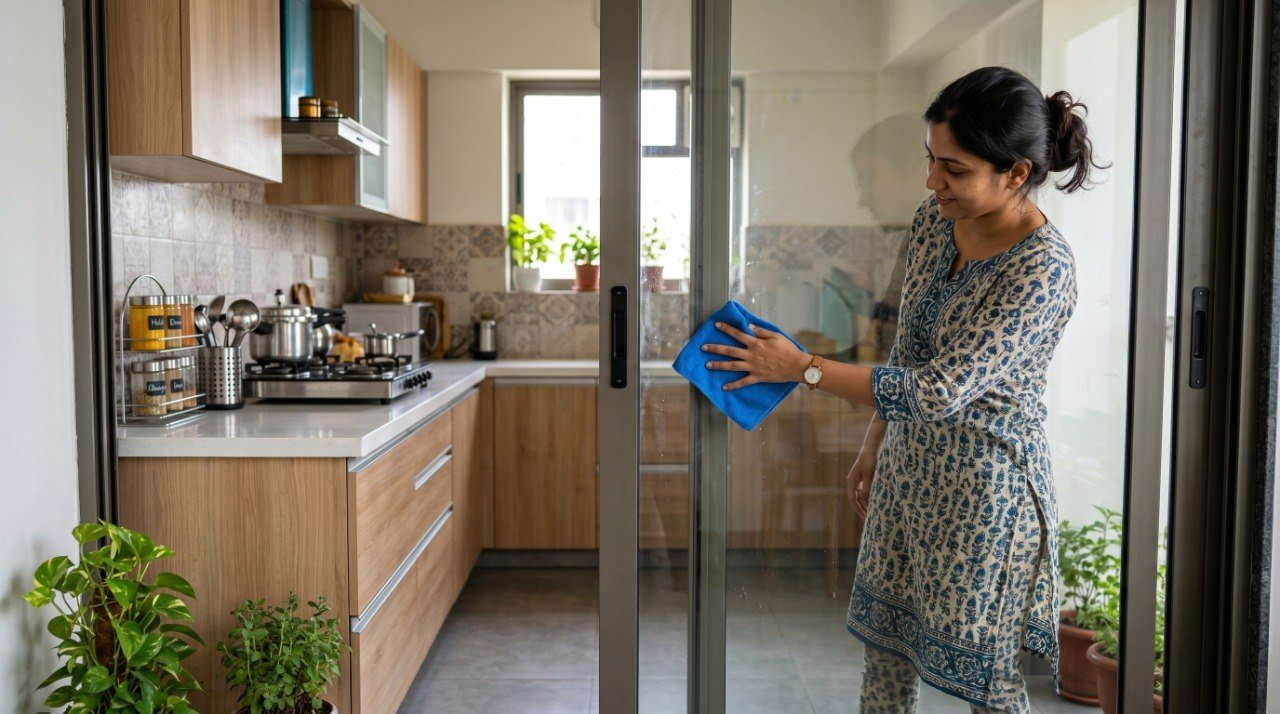
Track cleaning matters too. Dust and debris collect in the bottom track channel. Clean it every month or two — a dry brush works fine. If the door starts sliding stiffly, a small amount of silicone spray on the rollers fixes it immediately.
Toughened glass (IS 2553 Part 1 certified) is safe even if it breaks — it shatters into small, blunt pieces instead of sharp shards. This is important in kitchen environments.
How to Get a Quote from Vitraglass
Getting a quote is straightforward. We don’t do hard selling — if our product isn’t right for your space, we’ll tell you that too.
Here’s how it works:
- You share your kitchen opening dimensions (rough is fine)
- We schedule a free site visit at your convenience
- Our team measures and recommends the right glass type and hardware
- You get a written quote within 24 hours
- Fabrication starts after confirmation — ready in 7–10 working days
We’ve completed 500+ glass projects across Mumbai, Pune, and Hyderabad. We’re not the cheapest option, but we’re transparent about pricing and don’t cut corners on glass quality or hardware.
Contact Vitraglass for a free site measurement and quote →
Frequently Asked Questions
What is the best glass thickness for a kitchen sliding door?
For kitchen use, 10mm toughened glass is the sweet spot — strong enough to handle daily use, not too heavy for standard hardware. 8mm works for smaller panels under 3 feet wide. Avoid 6mm for kitchen sliding doors.
How much does a kitchen glass sliding door cost in Mumbai?
Prices range from ₹550 to ₹1,400 per sq ft depending on glass type, frame style, and hardware quality. A standard 3×7 ft kitchen sliding door typically costs ₹12,000 to ₹28,000 fully installed. Get a site visit before finalising any quote.
Is toughened glass safe for kitchen use near a gas stove?
Yes, IS 2553 Part 1 certified toughened glass is heat-resistant and safe for kitchen environments. Just ensure the door isn’t installed directly adjacent to an open flame — maintain at least 600mm clearance from the burner.
Can I install a glass sliding door in a small Mumbai kitchen?
Yes, and it actually works better than a swing door in small kitchens because it doesn’t eat into floor space when open. A single panel sliding door needs only wall space, not swing clearance.
What is the difference between frameless and aluminium-framed kitchen sliding doors?
Frameless doors use patch fittings and top-hung hardware — cleaner look, higher cost, needs precise installation. Aluminium-framed doors have a visible slim profile frame — more forgiving in uneven walls, easier to maintain, lower price point.
How long does installation take for a kitchen glass sliding door?
Fabrication takes 7–10 working days after order confirmation. On-site installation is typically done in half a day for a single panel. Dual-panel or frameless installs may take a full day.